Ficin Enzyme for Meat Tenderization: Formulation Guide for Industrial Buyers
Formulate with industrial ficin enzyme for meat tenderization: dosage, pH, temperature, QC, COA/TDS/SDS, pilot validation, and supplier checks.
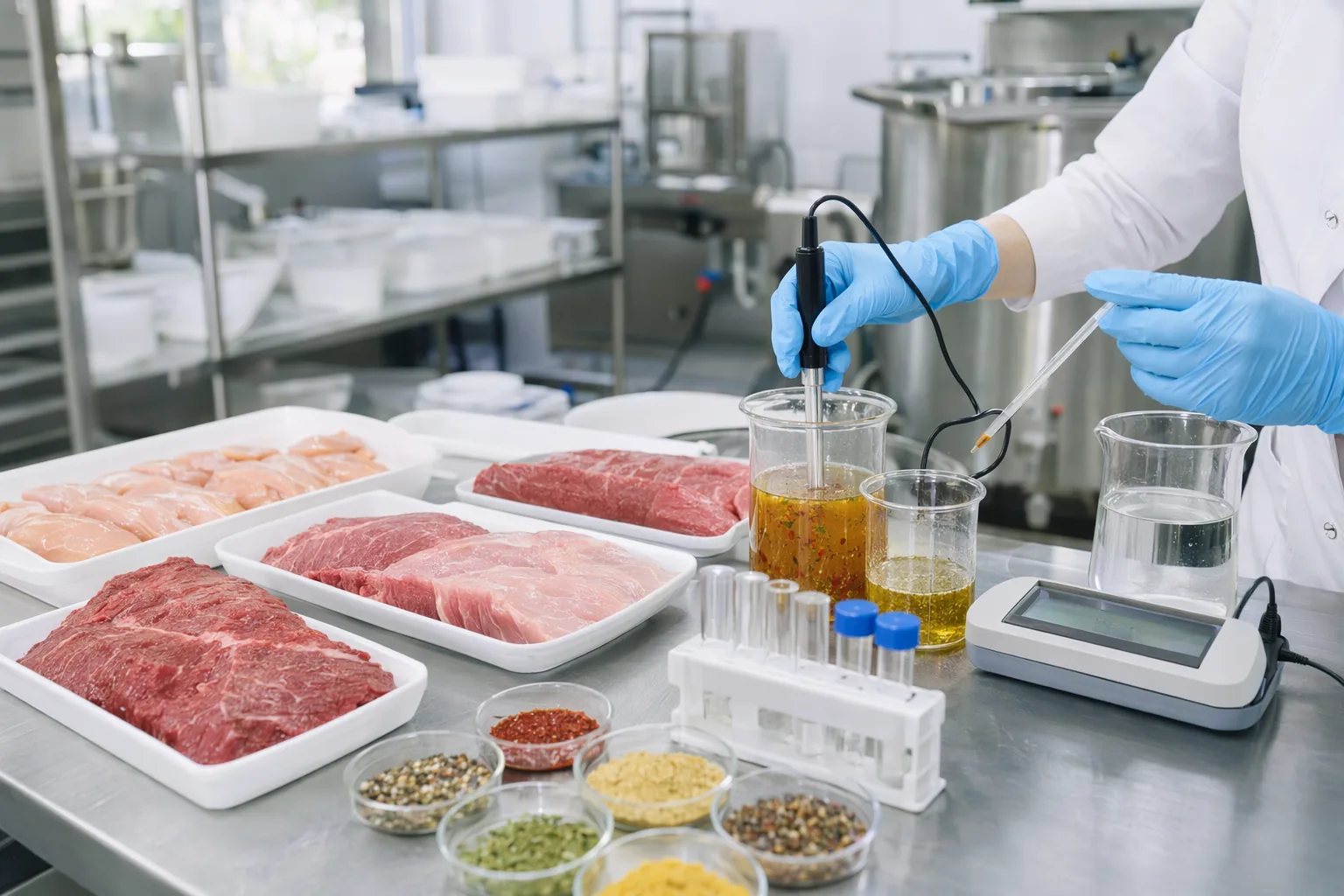
Ficin is a plant-derived protease from fig latex used to modify meat proteins, improve bite, and support consistent tenderness in marinades, injection brines, and tumbling systems. Buying for production or resale? Request a quote with the product, quantity and destination country, using the form on our home page or the email address in the footer.
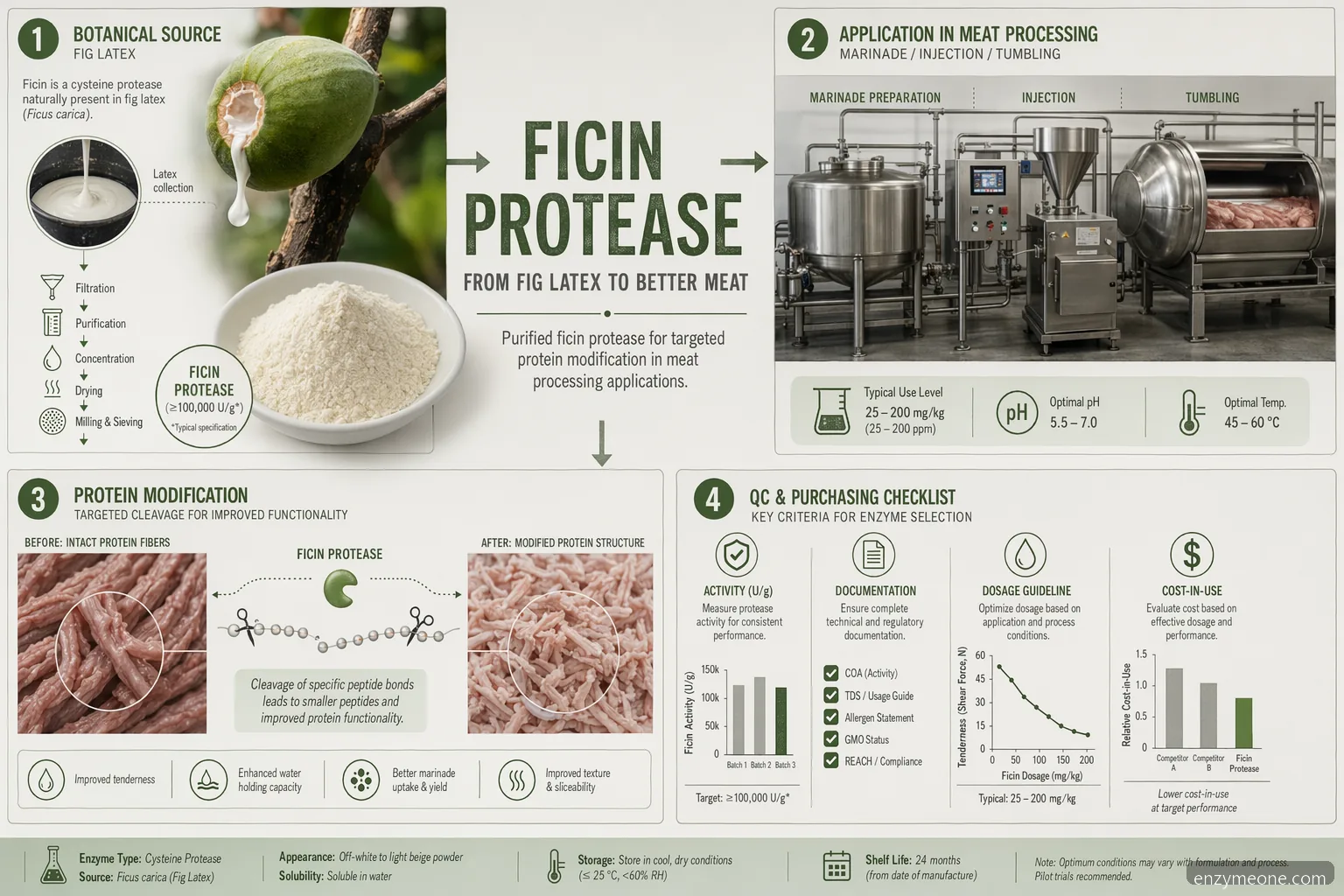
Why Use Ficin in Meat Tenderization Formulations
Ficin is a cysteine protease naturally associated with fig latex and is commonly evaluated as a fig enzyme for meat tenderization. In processed meat systems, it hydrolyzes selected muscle proteins and connective tissue components, helping reduce toughness when properly controlled. For B2B formulators, the value of ficin is not simply enzyme strength; it is predictable performance under real plant conditions. Brine composition, meat cut, phosphate use, salt level, chilling time, and heat treatment all influence the final texture. Compared with relying only on mechanical tenderization, industrial ficin meat tenderization can be dosed, documented, and validated across production lots. It is suitable for processors developing beef, pork, poultry, or restructured meat products where controlled bite and consistency are required. The best results come from pilot work that matches the actual injection, tumble, marination, storage, and cooking process.
Plant-derived protease for protein hydrolysis in meat systems • Useful in marinades, injection brines, tumbling, and topical applications • Requires controlled exposure to avoid mushy texture
Application Methods: Injection, Tumbling, and Marinades
Industrial ficin enzyme meat tenderization depends on even distribution. For whole-muscle products, ficin can be incorporated into brines or marinades used for injection, vacuum tumbling, immersion, or combination processes. Injection improves delivery into thick cuts, while tumbling supports dispersion and protein extraction in value-added meats. For smaller pieces, diced meat, or restructured products, direct addition through a pre-dispersed enzyme solution may be more practical. The enzyme should be fully hydrated and dispersed before contact with meat to avoid localized over-tenderization. Process teams should monitor pump shear, brine temperature, hold time, and dwell time before cooking or freezing. If the product is cooked, a validated heat process may reduce residual protease activity; if sold raw, cold-chain control and dosage precision become even more important.
Use pre-dispersion to reduce enzyme hot spots • Validate injection uniformity and pickup rate • Track dwell time between application and cooking • Assess texture after storage, cooking, and reheating
Recommended Processing Conditions
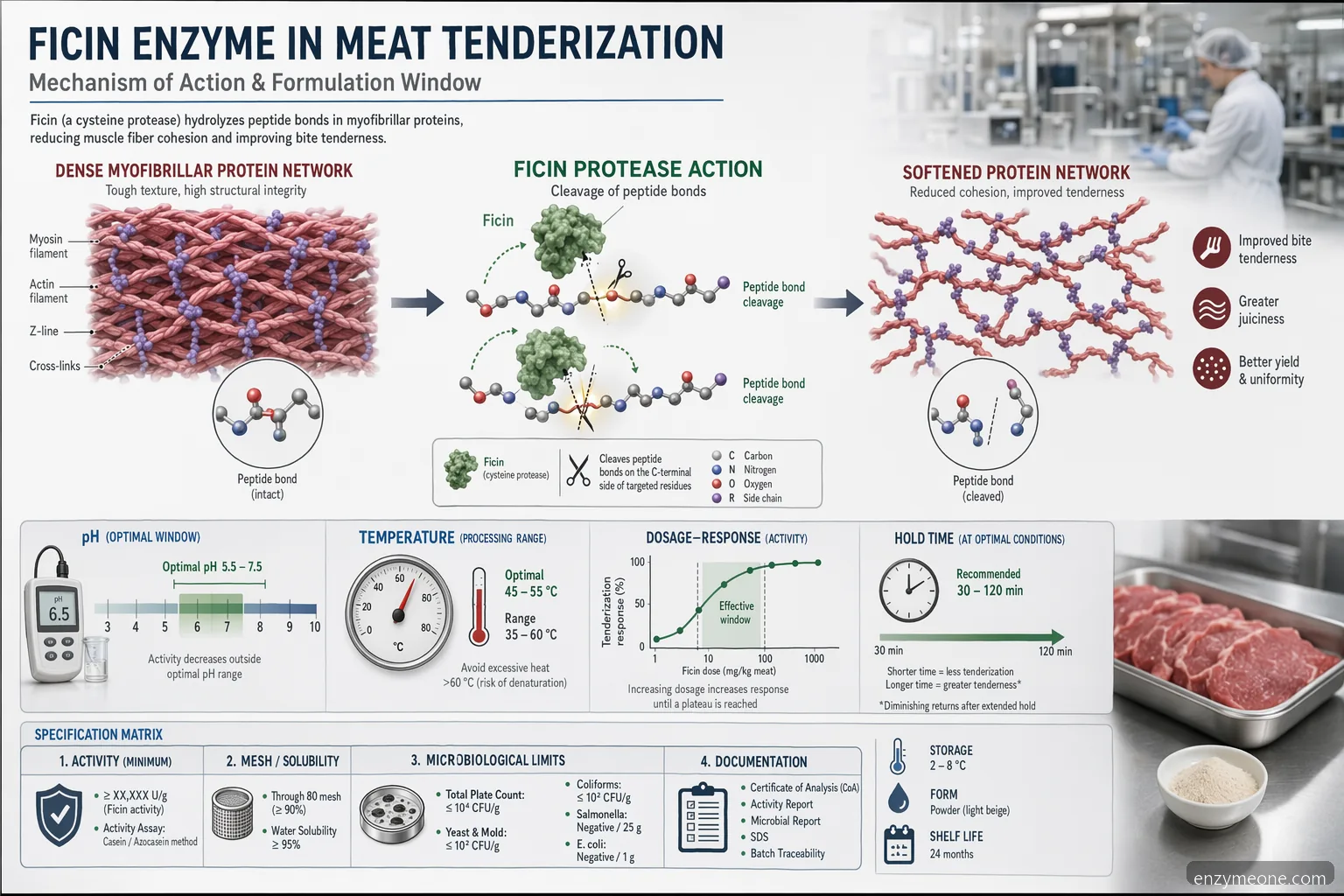
For ficin enzyme for meat tenderization, formulation trials commonly begin around pH 5.5 to 7.5, with many meat brines operating near pH 5.8 to 6.8 depending on salt, phosphate, acids, and flavor systems. Temperature is a major control point: refrigerated holding slows proteolysis, while warm processing accelerates activity. Practical meat operations often dose the enzyme into chilled brines, inject or tumble at 0 to 8°C, and rely on time to control tenderization. Ficin may show higher catalytic activity at warmer temperatures, often evaluated in bench assays around 40 to 60°C, but those conditions can be unsuitable for raw meat quality or food safety without validated controls. Heat cooking can reduce residual enzyme activity when the product reaches an adequate thermal process. Because commercial ficin preparations differ, dosage should be based on declared activity units and verified through pilot batches.
Initial pH trial range: 5.5 to 7.5 • Chilled processing: typically 0 to 8°C for brines and tumbling • Activity increases with temperature, so contact time must be controlled • Thermal cooking can help limit continued proteolysis
Dosage Strategy and Formulation Development
A practical starting range for industrial ficin enzyme meat tenderization is often 0.01% to 0.10% of a commercial enzyme preparation by finished meat weight, or a supplier-recommended activity-unit dosage per kilogram of meat. Because activity units are not standardized across all suppliers, buyers should not compare products by inclusion percentage alone. Begin with a three-point or five-point dose ladder, then evaluate tenderness, sliceability, purge, cook yield, and flavor impact. In injection systems, confirm enzyme solubility and brine stability before production. In tumbling systems, track pick-up percentage, vacuum level, tumble time, and rest time. For topical treatments, uniform distribution is the limiting factor. A ficin enzyme supplier for meat tenderization should help translate activity data into cost-in-use, expected processing windows, and practical handling instructions. The goal is controlled tenderization, not maximum proteolysis.
Suggested first trial: 0.01% to 0.10% commercial preparation • Use dose ladders rather than one-point trials • Compare by activity and performance, not price per kilogram only • Confirm enzyme compatibility with brine ingredients
Common Troubleshooting Issues in Plant Trials
When industrial ficin enzyme meat tenderization gives inconsistent results, the root cause is often process distribution rather than enzyme chemistry. Uneven injection patterns, blocked needles, poor vacuum tumbling, variable meat thickness, and inconsistent dwell time can create patchy texture. If the surface becomes mushy while the center remains tough, reduce dosage, improve distribution, or extend mechanical mixing at lower enzyme strength. If tenderness is insufficient, check that the enzyme was not exposed to excessive heat, oxidizing sanitizers, or incompatible ingredients before use. Salt, phosphate, acidulants, and marinades can influence pH and water binding, so the complete formulation must be tested. For an industrial fig enzyme meat tenderization program, trend each batch by pickup, pH, temperature at addition, hold time, cook yield, and texture results.
Mushy surface: lower dose or improve penetration • No effect: verify activity, storage, pH, and exposure to heat • High purge: review protein breakdown level and marinade balance • Patchy tenderness: audit injection or tumbling uniformity
Quality Control Checks for Scale-Up
QC should connect enzyme treatment to measurable finished-product outcomes. For ficin for meat tenderization, useful checks include raw material specification, brine pH, solution temperature, injection pick-up, dwell time, purge, cook loss, and finished texture. Texture profile analysis, Warner-Bratzler shear force, slice integrity, bite panel scoring, or internal sensory standards can all support decision-making. Over-tenderization is a real risk, especially when contact time extends during chilled storage or when the same enzyme dosage is used on thinner cuts. Microbiological controls must follow the processor’s validated food safety plan, because enzyme use does not replace sanitation or lethality requirements. Record the enzyme lot number, activity, date opened, storage conditions, and use rate in batch documentation. For industrial fig enzyme meat tenderization, repeatability matters more than a single successful bench result.
Measure pH, temperature, pick-up, dwell time, purge, and cook yield • Use objective texture testing where possible • Track enzyme lot and activity in batch records • Validate results on the actual meat cut and process line
Comparing Ficin With Other Protease Options
Comparison intent matters because ficin is rarely evaluated in isolation. Meat processors may compare ficin with papain, bromelain, microbial proteases, or blended systems. Ficin may be selected for a specific tenderization profile, plant enzyme positioning, or performance in a defined pH and temperature window. However, a different protease may be more economical if it reaches the target texture at a lower cost-in-use or with less risk of over-tenderization. The practical comparison should use equal finished-product targets rather than equal grams of enzyme. Standardize meat block, brine, pH, salt, tumbling energy, hold time, and cook schedule. Then compare yield, texture, sensory acceptance, rework risk, labeling requirements, and operational simplicity. Industrial ficin protein hydrolysis experience may also be relevant if the supplier understands controlled proteolysis, but meat tenderization needs its own validation because intact muscle behaves differently from slurry hydrolysis.
Compare on cost per accepted kg of finished product. • Include rework, purge, and rejected texture in the cost model. • Avoid switching enzymes without revalidating time-temperature controls.
Supplier Qualification and Documentation
When selecting a ficin supplier for meat tenderization, request technical and quality documentation before quoting large volumes. A complete file typically includes a current COA, TDS, SDS, declared enzyme activity, test method reference, recommended storage conditions, shelf life, carrier or excipient information, allergen statement, and country-of-origin details where required. Buyers should also ask about lot-to-lot activity control, packaging sizes, lead times, sample availability, and change-notification practices. Avoid assuming that all ficin products are interchangeable; commercial preparations can vary in concentration, carrier system, moisture, particle size, and solubility. A qualified fig enzyme supplier for meat tenderization should support bench testing, pilot validation, and scale-up troubleshooting without making unsupported claims. For regulated markets, confirm that the material is appropriate for the intended food application and local compliance requirements before commercialization.
Request COA, TDS, SDS, activity data, and storage guidance • Confirm carrier system, solubility, and lot traceability • Ask for samples for pilot validation • Review change-control and supply continuity • Ask whether activity is reported by an internal or recognized assay • Compare performance in your own substrate and process, not only unit price
Cost-in-Use and Purchasing Considerations
The lowest enzyme price per kilogram is not always the lowest cost-in-use. For ficin meat tenderizer applications, cost depends on activity strength, dosage, yield improvement, reduced toughness variation, brine compatibility, labor impact, and reject reduction. A more concentrated ficin enzyme may cost more per kilogram but require lower inclusion and less storage space. Conversely, a diluted product may be easier to handle but less economical at scale. Buyers comparing industrial ficin enzyme meat tenderization options should run side-by-side trials using equal activity targets and the same meat lot. Include texture results, purge, cook loss, rework, line speed, and customer complaint risk in the evaluation. For high-volume processors, supplier reliability, documentation quality, and technical response time can be as important as unit price. Procurement and R&D should approve the product together.
Compare equal activity, not equal weight • Include yield, rework, and reject reduction in cost models • Validate handling and storage requirements • Align procurement, QA, and R&D before approval
Wholesale Supply and Quote Requests
We supply ficin powder to meat processors, marinade and seasoning makers, and ingredient distributors who buy by quote. The specification on file is activity 0.5–2.0 U/mg (casein assay), working range pH 5.0–8.0 and 45°C–65°C, cream to tan powder from Ficus carica latex, 12-month shelf life sealed (-20°C recommended). Standard packs are 100 g, 500 g and 1 kg with a 100 g minimum order, so a first lot can be validated in a pilot run before a production order; larger volumes are quoted per order. Each lot ships with its CoA. Distributors reselling into meat processing should confirm with their customers that the grade suits the intended food application and local rules before commercial use.
Send: product and activity range • Application (injection, tumbling, marinade) • Quantity per order or per month • Preferred pack size • Destination country
Technical Buying Checklist
Buyer Questions
Ficin is a protease that hydrolyzes meat proteins, helping reduce toughness when dose, time, pH, and temperature are controlled. It can be used in brines, marinades, tumbling systems, and topical applications. For industrial use, the key is not simply enzyme potency but repeatable tenderness, acceptable yield, stable flavor, and validated performance across the processor’s actual raw materials and production conditions.
A common first screening range is 0.01% to 0.10% of a commercial ficin preparation by finished meat weight, but the correct level depends on declared activity, meat cut, brine composition, temperature, and contact time. Because activity units vary by supplier and method, run a dose ladder and compare finished texture, purge, cook yield, and sensory results before approving a production dosage.
Yes, many processors evaluate ficin in injection brines, but solubility and compatibility must be confirmed. Check brine pH, salt, phosphate, gums, flavor systems, and temperature before scale-up. The enzyme should be dispersed uniformly, and the process should track injection pick-up, dwell time, and finished texture. Request the supplier’s TDS for recommended hydration and handling practices.
A qualified supplier should provide a COA, TDS, SDS, declared activity, test method reference, storage conditions, shelf life, carrier information, allergen statement, and lot traceability. For food manufacturing, buyers should also review sample availability, lead time, packaging, change-notification practices, and technical support. These documents help QA, R&D, and procurement evaluate suitability before plant trials.
Over-tenderization is controlled by lowering dosage, reducing contact time, maintaining chilled processing temperatures, and validating cooking conditions that limit continued enzyme activity. QC should include shear force or texture profile analysis, sensory bite checks, purge, sliceability, and cook yield. Trials should use the same meat cut, thickness, brine pick-up, and storage time expected in commercial production.
Ficin for Research & Industry
Need Ficin for your lab or production process?
ISO 9001 certified · Food-grade & research-grade · Ships to 80+ countries
Frequently Asked Questions
What makes ficin useful for industrial meat tenderization?
Ficin is a protease that hydrolyzes meat proteins, helping reduce toughness when dose, time, pH, and temperature are controlled. It can be used in brines, marinades, tumbling systems, and topical applications. For industrial use, the key is not simply enzyme potency but repeatable tenderness, acceptable yield, stable flavor, and validated performance across the processor’s actual raw materials and production conditions.
How much ficin enzyme should be used in a meat formulation?
A common first screening range is 0.01% to 0.10% of a commercial ficin preparation by finished meat weight, but the correct level depends on declared activity, meat cut, brine composition, temperature, and contact time. Because activity units vary by supplier and method, run a dose ladder and compare finished texture, purge, cook yield, and sensory results before approving a production dosage.
Can ficin be added directly to an injection brine?
Yes, many processors evaluate ficin in injection brines, but solubility and compatibility must be confirmed. Check brine pH, salt, phosphate, gums, flavor systems, and temperature before scale-up. The enzyme should be dispersed uniformly, and the process should track injection pick-up, dwell time, and finished texture. Request the supplier’s TDS for recommended hydration and handling practices.
What documents should a ficin enzyme supplier provide?
A qualified supplier should provide a COA, TDS, SDS, declared activity, test method reference, storage conditions, shelf life, carrier information, allergen statement, and lot traceability. For food manufacturing, buyers should also review sample availability, lead time, packaging, change-notification practices, and technical support. These documents help QA, R&D, and procurement evaluate suitability before plant trials.
How do processors prevent over-tenderization with ficin?
Over-tenderization is controlled by lowering dosage, reducing contact time, maintaining chilled processing temperatures, and validating cooking conditions that limit continued enzyme activity. QC should include shear force or texture profile analysis, sensory bite checks, purge, sliceability, and cook yield. Trials should use the same meat cut, thickness, brine pick-up, and storage time expected in commercial production.
How should ficin be compared with papain or bromelain?
Compare ficin, papain, bromelain, or microbial proteases under the same meat block, brine, pH, dosage basis, contact time, and cook schedule. Do not compare only price per kg or label activity. Compare finished-product texture, yield, purge, sensory quality, process robustness, documentation, and cost per accepted kg. Ficin may be preferred in some systems, while another protease may be better in others.
Wholesale Ficin Supply: Request a Quote
For meat processors, marinade makers and ingredient distributors. Email the product, application, quantity and destination country, and we reply with pricing, CoA and pack options (100 g / 500 g / 1 kg; larger volumes quoted per order). See our application page for Ficin Enzyme Uses for Industrial Proteolysis at /applications/ficin-enzyme-uses/ for specs, MOQ, and a free 50 g sample.
Contact Us to Contributehello@mail.enzymeone.com